
Parenting Plans Gwynedd

Making a Parenting Plan for the Child Through Family Mediation
 
One of the main worries for parents splitting up is to make sure their children have a stable environment. A good parenting plan sets out the practical arrangements for children in a way that is reasonable and agreed by both parents, minimises disputes, and reduces the risk of misunderstanding.
 
At British Family Mediation Service, our experienced family mediators help parents develop clear, realistic parenting plans that work for their unique family circumstances. Whether you’re separating amicably or communication has become difficult, mediation can help you reach agreements without the stress, cost and uncertainty of court.
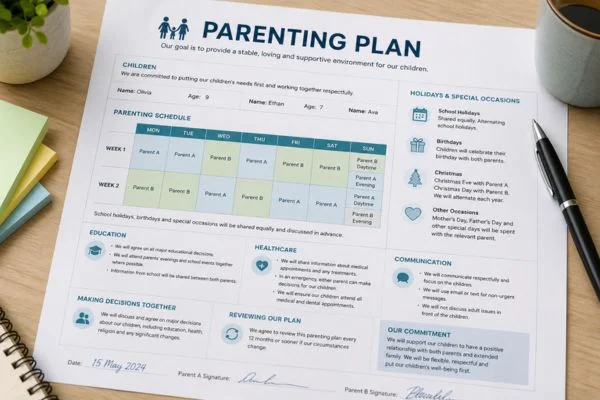
Image of parenting plans Gwynedd in progress

What Is a Parenting Plan?

A parenting plan is a document that outlines how separated parents will continue to take care of their children.

It clarifies what is expected day to day and which decisions need everyone to know what has been determined.
Parental plans are meant to be flexible, and you can revisit them as children age or the family situation changes. The focus is always on putting your children’s needs first and very much supporting the concept of positive co-parenting.
 
It is widely recommended that separated parents provide practical help to each other in how they will work together in the best interests of their children, and so parenting plans are popular.

What Can a Parenting Plan Gwynedd Include?

Every family is different, but your parenting plan may include:

Living Arrangements

  • Where your child will live
  • Shared care arrangements
  • Overnight stays
  • Weekly routines

Time With Each Parent

  • Weekday contact
  • Weekends
  • School holidays
  • Christmas and birthdays
  • Mother’s Day and Father’s Day
  • Special family occasions
School and Education
  • School choices
  • Parents’ evenings
  • Homework expectations
  • Extracurricular activities
  • School transport
Healthcare
  • GP and dentist appointments
  • Medical treatment
  • Medication
  • Emergency decisions
  • Mental health support
Communication
  • How parents communicate
  • How children contact each parent
  • Video calls and phone calls
  • Emergency contact arrangements

Financial Matters

Whilst financial issues are normally dealt with separately, your parenting plan can identify responsibilities for:
  • School trips
  • Uniform
  • Clubs and activities
  • Equipment
  • Shared expenses

Future Decision Making

Agreeing how major decisions will be made can prevent future disagreements, including:
  • Education
  • Religion
  • Healthcare
  • Overseas travel
  • Passport applications

Why Is a Parenting Plan Important?

happy child with parent after parenting plans Gwynedd
Having a written parenting plan offers many benefits.
It can:
  • Reduce misunderstandings
  • Minimise conflict
  • Create consistency for children.
  • Improve communication
  • Give children greater stability.
  • Avoid unnecessary court proceedings.
  • Provide reassurance for both parents.
  • Make future decisions easier.
Children generally benefit when parents can work together respectfully and provide predictable routines following separation.
Will Mediation Help Us Make a Parenting Plan?
Absolutely.
With family mediation, both parents discuss arrangements in a neutral setting and with the help of an independent mediator.
Mediation helps stimulate a constructive dialogue that aims to get both parents to reach a practical agreement focused on the child’s needs, rather than one parent dictating.
Your mediator can help you discuss:
  • Child arrangements
  • Holiday schedules
  • Communication
  • Shared parenting
  • Future flexibility
  • Managing disagreements


Is a Parenting Plan Legally Binding?

A parenting plan itself is not usually legally binding.
However, many parents successfully follow their agreed parenting plan because they have both contributed to creating it.
If required, agreements reached during mediation may be capable of forming part of a legally binding arrangement through the appropriate legal process where useful legal advice is obtained. Your mediator can explain the available options.


Who Needs a Parenting Plan?

It is particularly advisable for parents who:
  • Divorcing
  • Separating
  • Never married
  • Civil partners separating
  • Revising existing child arrangements
  • Experiencing communication difficulties
  • Wanting to avoid court
Our Parenting Plan Process
Understand parenting plans Gwynedd

Step 1 – Book Your MIAM

Meet privately with one of our experienced family mediators to discuss your circumstances and determine whether mediation is suitable.

Step 2 – Invite the Other Parent

If mediation is appropriate, the other parent will be invited to attend their own confidential MIAM.

Step 3 – Joint Mediation Sessions

Together, you’ll work through each aspect of your parenting plan at a pace that works for everyone.

Step 4 – Record Your Agreements

Once you’ve reached agreement, your mediator can prepare documentation recording the parenting arrangements discussed.

Why Choose British Family Mediation Service?

When you choose British Family Mediation Service, you’ll benefit from:
  • Experienced family mediators
  • Child-focused approach
  • Online Dispute Resolution in England and Wales
  • Flexible appointments
  • Confidential discussions
  • Cost-effective alternative to court
  • Support with MIAMs
  • Providing straightforward, unbiased advice along the way
  • Our key focus is to ensure that each family has the confidence to move on, while keeping children’s wellbeing at the heart of all conversations.
Frequently Asked Questions
Why have a Parenting Plan?
 
In other words, a parenting plan gives separated parents guidance to help them care for their children and minimise conflict and uncertainty.
 

What should be included in a parenting plan?

Most parenting plans include living arrangements, contact schedules, school holidays, communication, education, healthcare, travel and arrangements for special occasions.
 
Can the parenting plan be modified?
 
Yes. Parenting plans are meant to be flexible and can always be revised as children mature or situations change.
 
Does it require mutual parental consent?
 
Yes. The goal of mediation is to facilitate voluntary agreements between parents that will work better for the whole family.
 
What if we cannot agree?
 
In the absence of immediate agreement, additional mediation sessions may assist. There may be other legal avenues available to you where mediation is not appropriate or unsuccessful.
 
Incorporate the Grandparents into a Parenting Plan
 
Yes. During mediation, if relevant, provisions for contact with grandparents or extended family members can be discussed.


How long does it take to create a parenting plan?

This varies depending on the complexity of your circumstances and how many issues need to be discussed. Some families reach agreement in one or two sessions, while others require additional meetings.


Is mediation better than going to court?

For many families, mediation is quicker, less stressful and more cost-effective than court proceedings. It also allows parents to retain greater control over the decisions affecting their children.
Take the First Step Today
Creating a thoughtful parenting plan can give your children the stability they need while helping you and your co-parent move forward with greater confidence.

If you're ready to discuss your child arrangements, book a MIAM with British Family Mediation Service today. Our experienced mediators are here to help you create practical, child-focused parenting plans that support your family's future.

Book your MIAM today or contact British Family Mediation Service to find out how mediation can help you create a parenting plan tailored to your family's needs.